


(This blog was co-written with my colleague Cor Veenman)
“My four-year-old nephew can do this, too!” That’s the stereotypical reaction of some people to modern art. That criticism relates to the traditional role of painting: to represent reality as skilfully as possible. When photography became available in the 19th century, a debate followed. Doesn’t photography spell the end of painting? After all, it’s quicker and easier to use a photograph to record reality. There was also the question of whether photographers could be considered artisans, let alone artists: the device does the job.
We now know that the art of painting has not disappeared. What’s more, there has been an explosion of new movements. Photography has taken over some work for which we used to hire painters. This apparently created room for us to ask ourselves: what can a painting offer that a photo cannot?
Interestingly, photography has become an art form in itself. The goal is no longer to record reality as precisely as possible. Working with composition, lighting and shutter speeds, and using tricks to influence reality, involves skills that can lead to highly artistic results for some photographers, though perhaps less so for others.
However, not all photography is art. Actually, many photos have become disposable products. How many photos do we take with our smartphones and never look at again? The parallel with AI is already clear here: how many texts are written these days? Writing a text yourself takes effort, just as painting or drawing does. Creating a text with AI is just as effortless as taking a picture.
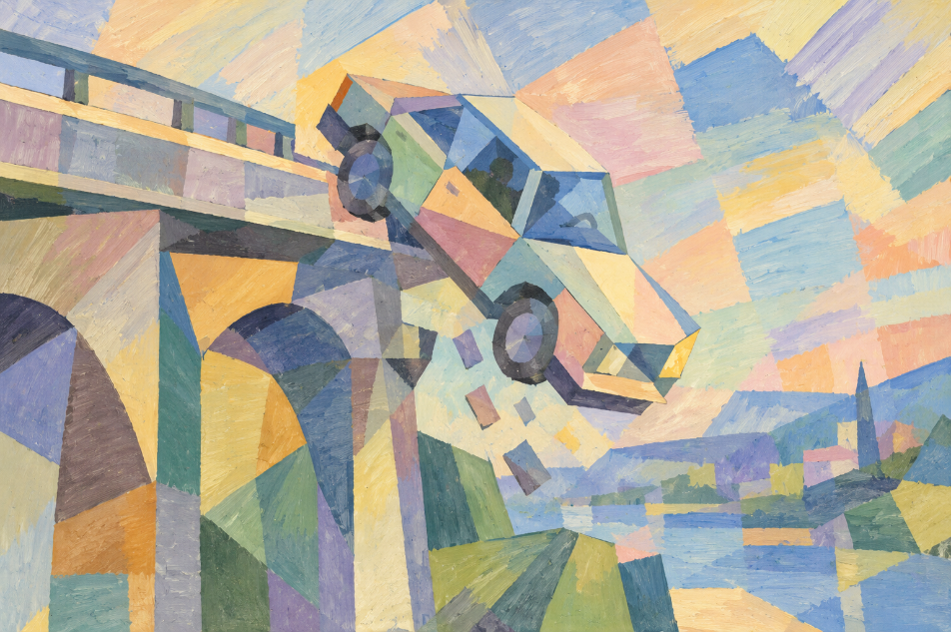
As with painting, generative AI can be used to create images that do not have to reflect reality. There is no need to produce the finished work through painstaking effort: it is possible to work with images conceptually. “Create an image of a car driving across a bridge in a cubist style. Use pastel colours and broad brushstrokes.”
From image to sounds
With the introduction of the gramophone, live concerts could be expected to become less attractive.
But live concerts remained important. The experience is totally different, and especially in the beginning, the sound quality was much better. When the record industry became more omnipresent, live performances became a way to stimulate the record sale. Interestingly, this changed when albums became digital (CD, mp3, streaming): recorded music became available widely and became so cheap that it lost its importance as main stream of revenue. Instead, recorded music seems to become the promotion for live concerts.
Just like with photographs, the use of technology has made music much more widely available. This has led to a category of music that is much less appreciated: background music. In its most pure form, it is called ‘muzak’, which has almost disappeared by now. Fun fact: the composer Erik Satie positioned his music as background music (‘musique d’ameublement’) too, but has become quite influential for minimal music.
Technology has always had big role in music, and there have always been discussions about what is ‘real’. Electronic instruments like synthesizers and samplers created different kinds of music. There was excitement brought about by frontrunners like Jean-Michel Jarre, Daft Punk and Kraftwerk. It was possible to create sounds that had never been heard before. Additionally samplers, made it also possible to reuse sounds that have been heard before. Now these instruments are very commonplace, and the discussion has mostly been silenced.
The only exception is the autotune (that corrects the singer’s off-notes) which is frowned upon. This device stirs feelings similar to when you see a teenager on a fatbike: do you really need that? Can’t you do it yourself? What are you doing here, anyway?
There’s an ongoing debate about digital versus analog, though
Since digital music was introduced, especially when MP3 became available, there has been discussion on the ‘warmth’ that you hear in analog recorded and reproduced music. Digital music sounds ‘colder’ than music from vinyl or cassettes. Others criticize this: they say that this ‘warmth’ is a result of imperfect technology, leading to all kinds of distortions and thus not reproducing reality (note the parallel with paintings in the introduction). Because audiophiles have become used to these distortions, they interpret that as the only real way to play recorded music. Our appreciation can apparently be based on adaptation.
What about the influence of AI on music? The amount of AI-generated music on Spotify increases. Some ‘artists’ are even popular, like The Velvet Sundown or Sienna Rose. When using Generative AI, it is no longer necessary to use energy, attention and craftmanship to produce it with all its details. You don’t have to play every note yourself to elaborate a musical idea – this is a way of working that can be found in Hyperpop. This genre has always been using electronics a lot and have embraced many different tools, increasingly also including AI.
Another interesting development at the other end of the scale is the music of a Canadian band, Angine de Poitrine. This style has been dubbed ‘anti-AI’ and could be compared loosely to abstract paintings of Picasso: completely different from traditional styles, but with a strange, very particular attractiveness.
Text: the most controversial area
For art forms like painting and music, apparently the creative process can be supported or even partly replaced, by classical technology (photo cameras, recording technology, sound effects). Those technologically supported varieties can find their own ways with new types of creativity, which can also lead to renewed energy in the original traditional art form. However, for technology that is not classical, AI, the impact on paintings and making music is so far limited.
For texts, technology plays a big role for recording, presentation or distribution. Other than sound and vision, producing text is an activity where technology (except maybe spell checking) did not play a role until recently. Then chatbots appeared.
Can AI be a technology that creates a creative impact for text? Are there people who invent creative prompts that lead to texts that everybody wants to read? And will the ‘artisanal’ way of writing texts lead to complete new directions, now AI takes care of all daily mundane texts, without spelling errors and in a consistent style?
For practical texts like manuals, nobody will have problems when AI is used to tidy things up. For other texts, the appreciation is different.
It is interesting to see the reactions to news that around 20% of opinion articles in Dutch newspapers is written using AI. And around 25% of questions in the Dutch parliament.
There was outrage. “I vote for people, not robots!”. Another letter to the editor referred to Descartes: “I think, therefore I am. So members of parliament that outsource thinking to a machine, do not exist!”. This shows that correct thinking is hard – after all, ‘I do not think, therefore I am not’ is not a logical corrolary to Descartes.
For text, creativity (like in painting and music) is important, but authenticity maybe even more. When you have not written something by yourself, you have not devised it. When you did not take the trouble to write something, why would I take the trouble to read it?
The AI-written social media messages of Dutch PM Rob Jetten got a lot of criticism. Apparently that was a bridge too far, because we do not criticize spin doctors or spokespersons to do that. Just as Rembrandt, who deployed students in his workshop, producing paintings under his supervision in his style. The Rembrandt Research Project has had a considerable job untangling all of this.
Here again, the role of generative AI is that it automates a lot of laborious work. This does not lead to texts that are very original and diverse for the time being. For professional literary writers this is a no go area, as Thélyson Orélien has experienced, even though his book was initially received well, receiving various nominations.
How different is writing texts using a Large Language Model from a DJ that remixes existing music into something new? Or a photograph, as artistic as it can be, isn’t that also just the result of a ‘prompt’ (scene, illumination, shutter speed, framing), leading to a result produced by a mechanical device? How different is that from prompting for a piece of text?
It’s imaginable that there are different ways to work with language in a creative way. “Write a one-page story about war at a distance. The first sentence is ‘I never thought war could be real’ and finish with the exact same sentence.” The problem? Such styles already exist, without the help of AI.
The (mostly French) Oulipo movement, that explores ‘potential literature’, applies all kinds of rules to explore new formats.
For instance, a lipogram: a text that does not use one or more specific letters, like in the novel ‘Gadsby’, of Ernest Vincent Wright: it contains 50 000 words but not a single letter ‘e’. Or texts in which every noun is replaced with the noun that becomes just before it in a standard dictionary. Many more delightful examples can be found in 82 Writing Experiments by Bernadette Mayer.
It’s hard to imagine that the pleasure of these authors can be experienced by a generative AI system (although for the description of some types of AI behaviour, you could consider to use such a term – see my previous blog). But one thing’s sure: the admiration of readers for the author will not be as big when they know that Claude or ChatGPT is behind it.
Can AI be compared to photo cameras and synthesizers?
Apart from the economic effects like loss of jobs (see: They’re taking our jobs!), there can be positive effects for the creative possibilities of AI: some tasks that could previously be done only with a lot of effort, are now reachable for many more people. Making a picture, write a text, creat music. So, more people can enjoy ‘creating’ things, even though the average quality may not be that high.
Looking back at earlier innovations in the creative world though, we can expect that there will always be the appreciation for real artisanal work, the fact that a human makes en effort. That’s why we want to know whether a painting is really produced by a Dutch Master. That’s why we want the ‘authentic’ text of an author. We want to get near to the creator. Is that still possible when art is produced conceptually with a few prompts?
Earlier innovations that automate craftmanship (photography, sound recording, synthesizers) have stimulated artists to find new directions in visual arts or music. Whether AI will have a similar effect is not yet clear. After all, surrealism has only become a major trend a century after the first photograph was taken. So we may need some time before we can witness those new art movements.
Related blogs:
- Red dots and red lines and Can submarines swim? Is it imaginable that AI takes pleasure creating something?
- They’re taking our jobs about AI-induced job replacment.
- Spoken language becomes written language becomes internet language – let’s pass on AI language: changes in our language because of AI.


Geef een reactie