


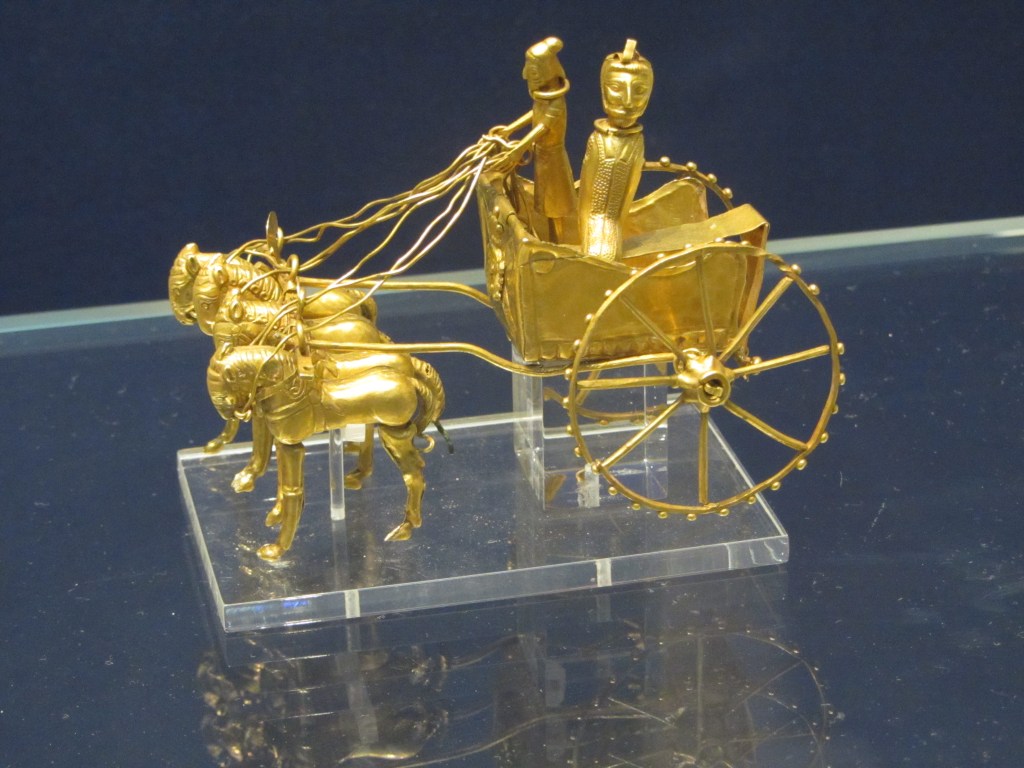
“When I had asked people what they wanted, they would have said: faster horses”. Henry Ford did not really say this, but there is a reason why the quote is so popular: it just happens so often that an innovation is initially used in the old-fashioned way of working. Once we get used to the innovation, there often emerges a new approach to it. The first cars were basically coaches without horses. Ford was one of the persons that contributed to the change into ‘real’ cars.
The development of information technology, in which AI is the latest chapter, is full of these examples.
Writing was initially used to lay down laws, describe ritual things, and for administrative purposes. After some time, people realized that you could also use it to write stories, something that Aristotle did not like. He was afraid that we would lose our abilities to learn stories by heart. (More about this in my blog Outsourced humanity.) Recording stories has become the most important function of books.
In ancient times, reading was still close to the storytelling tradition.
In ancient Greece or Rome, reading was not done silently, but aloud. Reasons were that words were not yet separated with spaces and interpunction: reading aloud makes it easier to distinguish the different words. Other reason was that texts were often read by slaves: a reader could be seen as ‘slave to the text’, and that is of course not fitting for a free citizen. They rather used agents avant la lettre for this.
The printing press, the second big revolution in information technology, was initially an imitation and scale-up of manual monastic labour. The first printed books, called incunables, tried to mimic the beautiful handwriting of those monks, including the calligraphed initials, that were added with woodprint. Only after around the year 1500, standardized fonts emerged and led to the adoption of the printed letter.
From paper to digital
The computer marks the next revolution in information technology. Under the hood, a completely new thing. What about its interface to humans? Yes, screens were used almost from the beginning, but the typewrite idea was still strong. In the 80s, there were still paper terminals in use: a printer with a built-in keyboard, where every typed character was printed directly. The computer output would also be printed. When I was invited, as a freshman student, to a gaming night with at the Computer Science department (some strategic space game), I had a stack of 15 centimeters of paper printed computer output as a souvenir.
The traces of the typewriter as predecessor to the computer are still easy to find: that funny QWERTY order of keys has resulted from the mechanical features of a typewriter. The more technical computer users will be familiar with ‘carriage return / line feed’. Carriage return is indeed what it is: the ‘carriage’ of a typewriter returning to the first column of the paper.
By the way: the revolution is not concluded yet. Computers were supposed to make paper obsolete, but we still use a lot of paper to print out digital texts. That’s why documents on computers are still formatted into pages. Remarkably, digital documents still pretend that they really belong on paper: A4 size, margins, fixed page breaks.
Internet, the next revolution in information technology, did say goodbye to paper as a reference: web pages are not restrained to A4 anymore. Unless the unprecedented speed of the internet revolution, embracing its full potential still took quite some time. In the 90s, shops were quite modern when they were “on the Internet, too”. (Note the capital and the definite article.) Anyone with a static website, providing your catalogue, the address, the phone number and maybe an email address, was well underway surfing the information super highway.
Until Amazon introduced a disruptive model. A physical store is not needed when you sell stuff! Many shopping malls have since then experienced the rise of e-commerce. Similar for packet delivery services and manufacturers of small vans, in a positive way. Another example is booking.com who have changed searching and booking hotel rooms considerably.
Email is basically still like sending a letter.
The address, the sender, and a subject line act as ‘envelope’. Emails start with a salutation and end with a signature, just like with that good old paper letter. The idea that you can have a conversation in which messages are grouped by contact, had to be invented by someone. On your old phone, text messages were presented in one big list, it was only in later versions that they were grouped by contact. The chat interface started with the CB Simulator, that simulated the Citizen Band radio network on computers. Initially, everybody’s contribution was displayed one after the other; only after some time (when IRC, Internet Relay Chat, was introduced), sentences were grouped together to make the conversation more easily interpretable. (This delightful example is described in Because Internet.)
Transformation
Internet was fast. After one generation, our way of living and working has changed considerably. It’s hard to imagine that only 30 years ago, some daily things were completely different. Buying tickets for a concert: find them online, click and pay; versus standing in a line for a ticket desk. Music: a playlist on Spotify versus buying a record at a store (or taping those hits from radio, avoiding the part where the DJ would be talking). Renting videos from a physical video library versus Netflix (who started off as a DVD rental service). Internet banking. Reading newspapers.
It’s so logical: there’s an innovation that makes work easier or more efficient. What do you do? You look at those steps that are now inconvenient or inefficient. The shop that can have email next to a telephone to have contact with customers: convenient! Or a catalogue that does not have to be printed and mailed (postal mail, that is), but can be downloaded from the website: efficient! As logical and convenient as it is, very often, when an existing way of working can be made more efficient, there’s a different way of working that’s even more efficient. The result is that existing successful companies are overtaken by new companies, that use technology in a different way. The pattern is: imitation, optimization, and then transformation.
Does AI follow a similar pattern?
AI exists for more than half a century now, but the current hype obviously started with ChatGPT. It was entertaining to chat with a computer program in stead of a human being: you are not contradicted, it was never tired or annoyed, and you could ask everything. The functional use of AI has been ‘asking questions’ from the beginning on. Basically, what you used Google for.
Making pictures with AI is an innovation that is on a different route.
To position that development, it is better to compare it with the excitement that was caused by the introduction of photography 150 years ago. Then there’s making music and short movies, too. A good topic for another blog.
When search engines were new, you had to be good in defining the right keywords. You could even use ‘logical operators’: ‘football’ AND (‘2025’ OR ‘2026’). When search engines became smarter, that was not needed anymore. I was completely surprised to see that people just typed a full sentence in a search engine, not keywords. And it worked! The step to chatting with AI is logical. Now that search engines summarize their results with ‘AI answers’, the difference between a search engine and AI has become even smaller.
In an office situation, besides ‘searching on the internet’, we now have ‘search in my inbox and our intranet’. Who does not experience the frustration of fruitlessly searching for that one factoid or that document? The AI search engine interprets your question, collects and analyses all relevant documents, and formulates the answer based on those documents.
In that same office, AI is used to summarize texts, translate or edit them. More advanced colleagues make ‘agents’ that can execute tasks in a more autonomous way, but these are all examples of taking the same steps as always, only more efficient.
Working differently
Will new ways of working develop? How does an ‘AI first’ company look like? The first experiments with the ‘one person company’ (or even ‘zero person company’, depending who you count) still have issues with reliability. AI hallucinates and sometimes makes really change choices. In the digital world (software, design, marketing), examples can be found, but also in that area there are issues to be solved: responsibility is an open issue, and it is also found that aspects like judgement (or taste, or intuition) are hard to outsource to AI. Yes, there are ‘lights out factories’, but that is more about robots than AI.
For programming with the help of AI, the jury is still out. Thinking along, doing suggestions and support fixing bugs: please! Most people argue that creating a quick demo with AI should be fine, but operational software made by AI is asking for trouble. Or not? There are more and more reports that Big Tech has the majority of its new software created by AI. Complemented by other reports that some of them are re-hiring sacked programmers. We are clearly in the experimental phase, but the conclusion seems to be that programming with AI acts as an amplifier: good teams become more productive, weak teams become chaotic even faster.
In life outside offices, not that many changes can be observed. Google and smartphones have made a quick factcheck during a conversation quite normal. Ordering something online and get it delivered the same day: nothing special. The difference is that the factcheck is not done by Google but by ChatGPT or some other AI. And those purchases? Many consumers expect that AI will help them with shopping, but to mandate an agent to completely take care of the transaction is too far out. There are quite a few hilarious examples where that has gone wrong, for instance OpenClaw ordering 40 garlic bulbs without his boss knowing about it.
In short: many things are tried out, in which AI is integrated in new ways into our work and our daily lives, but we do not yet know which ones will stick. Just like those faster horses turned out to be holy cows. Just as 25 years ago, we could not foresee in which ways internet would play a role in our lives and our work.
The development of AI is going faster than those other earlier innovations. The big changes should become visible in some 10 years from now. Let’s agree that I will write an update to this blog around 2035!
Related blogs:
- Outsourced humanity on the dangers of the information technology ‘book’ and the capability ‘reading and writing’
- Spoken language becomes written language becomes internet language – let’s pass on AI language on the impact of information technology innovations on our language


Plaats een reactie