
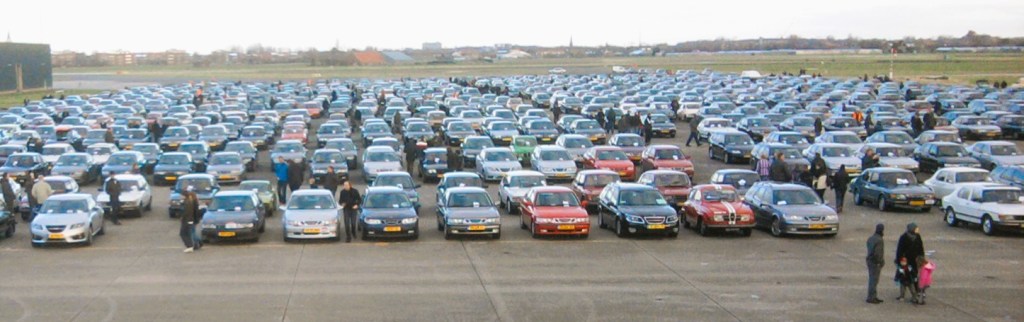
These days, when you ask someone what they think AI is, chances are that their answer contains ‘ChatGPT’, or at least another application that is based on language models. Understandable, but not correct. There are many more types of AI, all with different features.
The analogy between Generative AI (chatbots) and cars that I introduced before, helps to understand which types of AI there are. In this blog post, I will guide you through this fleet of vehicles.
The analogy
When we compare computer electronics to the invention of the wheel, the internet (‘the information highway’, we used to call it) can be compared to paved roads. Human knowledge, which is stored by computers and distributed over the internet, can then be compared to the muscle strength needed to move vehicles. Non-human knowledge, like the information in data and models, can then be compared to mechanical drive based on motors and fuel. Fuel makes you go faster, you can go farther with less effort – but there are some side effects, too.
There are many types of vehicles, with many different ways to drive them, and they all have some unique features: it’s a whole fleet. Let’s see how the analogy works.
The wheel = the computer
What was the first wheel used for? Probably for some wheelbarrow-like construction, so that you could transport heavy things at a farm or a building site. Coaches and carts already had more possibilities, but required more or less paved roads. The use of these vehicles was restricted by available muscle power, either human or animal. A more advanced vehicle is the bicycle: human power is used optimally here. It is much more complex, but you can still see and understand how it works, even though not everybody is still able to repair their own bikes. Racing bikes are super high tech and represent the maximum speed you can get out of human power.
The PC was used to store and process information; write texts with ‘word processors’ (as we called them), create databases to store addresses, and also to play games. Initially, many people were impressed with computers and considered them magical devices, but later on it dawned upon us that “you only get out of it what was once put into it”. Everything a computer did, was designed by humans.
Even though everything was designed by humans, some instances of computer behaviour could come across as magical: the famous chatbot ELIZA, created by computer scientist Joseph Weizenbaum in the mid 60s, worked based on simple rules, but it gave users the impression that they were chatting with a human. The term ‘artificial intelligence’, was born around that time. Designing and programming rules was the core approach in this field and it could lead to impressive results. Chess computers, for instance: all rules were created by humans (and surely not all chess grandmasters), but they worked so well that they could beat the world champion. Impressive, but even though there were many very clever programmers, there was a limit to what you could achieve purely based on human knowledge. (This type of AI was also called GOFAI – Good Old Fashioned AI, and when people realized that there are limits to this approach, this caused a so-called ‘AI Winter’).
Fuel and motors – data and models
Vehicles got a serious boost when the combustion engine was invented. Steam engines, petrol engines and diesel engines made human or animal muscle power unnecessary. The role of the human is nothing more than to steer the vehicles, it’s not needed to drive them. The introduction of the T Ford and the conveyor belt production turned cars into a mass consumer product.
Additional facilities are needed though, like a system to produce fuel and to distribute it too (gas stations, charging stations). Requirements for roads become more strict because speeds are higher and the roads are quite crowded; laws are needed to keep everything safe. There are some side effects, too: noise, smell and pollution.
Similarly, AI applications got a boost when the collection and storage of large amounts of data scaled up significantly and became cheap at the same time, and we found ways to build models with that data based on statistical techniques.
Simple applications of these data-driven applications could make recommendations (“people who bought this product, are also interested in …”). More advanced models that use a real lot of data (deep learning) were able to recognize objects in images, or do speech recognition. Most applications of this type of AI are found in company environments.
With all that data it is no longer needed to program human knowledge explicitly in rules. Just collect a lot of data, do some deep learning: ready! The role of the human is to invent more or less useful applications. Additional facilities are needed to collect all that data, to transfer and to store it. Also, laws are needed to limit boundless data collection practices. And there are side effects like privacy breaches and increasing energy use of data centers.
And all this was before November 2022.
The introduction of ChatGPT has turned AI into a mass consumer product. ChatGPT and its successors are a geared up version of ‘deep learning’ AI systems. Instead of relatively simple tasks like image recognition (“this product is rejected because of a production fault”) or speech recognition (“Siri, what’s the weather tomorrow?”), they could also produce texts and images. This is called Generative AI.
The first data-driven AI applications could be compared to motorcycles: one application, relatively efficient, and safe when you handle it right. The chatbots with their popularity and wide application would be cars. AI that is used for complex medical diagnostics or designing new medicines would be racing cars.
Vehicles and AI that change the physical world
So far, all presented vehicles and AI systems are meant to interact with humans. But motorized vehicles can do more than transport people. Fire trucks, cranes, and lawn mowers: they work on our physical environment. AI systems have a similar variety, which are then called agents. An agent can work on behalf of its user, by replying to emails, adjust the heating in the house, or order and pay groceries at an online store.
In the meantime, self-driving cars are popping up at various places around the world, with different levels of success. Imagine that there will be self-driving (and self-acting!) bulldozers, tanks and asphalt pavers! What could possibly go wrong?
Well… in the AI world, the equivalent of the self-driving chainsaw, snowplough and excavator already exist: the infamous OpenClaw that can fully autonomously do everything that you can do too behind your computer. Over the course of the last 10-20 years, we have equipped such a large part of our reality with a digital layer, that a bot like OpenClaw can manage a large part of our daily lives. And for those tasks that still need an actual human, they can rent a human.
How is this comparison insightful?
The use of muscle power for propulsion is tiresome, so it’s logical to automate that using engines that run on fuel. Similarly for computer systems that are based on explicit human knowledge: you have to think hard, collaborate and talk a lot to convert our knowledge into something a machine can execute. When you can automate that by just analysing loads of data, that is very attractive.
Fuel needs to come from somewhere, and the demand is so high (revisit my blog on the Jevons Paradox) that our own resources are not sufficient. A lot of geopolitical developments are driven by oil. (Two examples: the Gulf War would not have taken place when Iraq’s main export product would have been broccoli, and the Dutch East Indies were occupied by the Japanese in WW2 because of its oil reserves.) Additionally, the country’s population does not automatically benefit from having oil – see Venezuela or Nigeria.
Data is similar. Data colonialism is a term that has already been coined. Almost all AI Large Language models have been trained on data that was acquired without consent from the holders, let alone that they would receive a compensation for it. (All models? No, a small project in a small country is resisting.) There are more parallels between data and oil that I have elaborated in this blog post.
There’s another clear parallel: excessive use of fuel-driven cars for transportation is bad for our health because our muscles are under-used. Similarly, leaning on AI models that have replace our own thinking is bad for our own insights. Overly relying on GenAI creates worse decisions, just like using your car too much is bad for physical health.
One last parallel. Around vehicles, a whole system of laws and regulations has emerged. In the 19th century it was already mandatory to precede a ‘locomobile’ with a red flag. Traffic rules, drivers licences and safety requirements soon followed. Safety belts took a remarkable long time: in most countries, it was only in the 1970s that they became mandatory. It’s not only governments who are slow to adapt: safety belts experienced a period of resistance. “These things are very unsafe! When I drive my car into the canal, I cannot get out quickly enough!” (I can still hear my grandpa complaining.)
AI is not very different. The AI Act is criticized because it allegedly would impede innovation. Critics complain that Europe is only interested to take the moral high ground. Well: just like speed limits, alcohol prohibitions and safety belts were introduced quite late, measures in the digital are also lagging behind. The social media ban for youngsters could easily have been introduced 15 years ago. And even in the US there is now a court case against Facebook. So yes, just like in traffic, we need more deaths before also outside the EU there will be sensible rules. (The recent disagreement between Antrhopic and the US Ministry of War makes the risk of ‘deaths caused by AI’quite clear.)
Conclusion
When the development of vehicles had gone like AI today, it would have been quite a mess: people would go shopping in a racing car, or harvest the carrots in their garden with a combine harvester.
Sadly, that is what’s happening with AI today. When you ask ChatGPT to do arithmetic for you, or expect that a language model (language model, not fact model!) knows about the latest developments in your local football club, you are using tools that are totally not designed for this. Understandably: chatbots present themselves in a very convincing and all-knowing way. “OK, but we’re no AI researchers, how should we know what AI is designed for?” That’s exactly the reason why “AI literacy’ is so important.
The speed of AI developments in the last couple of years makes it difficult to become literate: the moment you more or less know how things work and what to use it for, something new arrives. In that regard, the slower development of vehicles was easier to handle because everybody could get used to the fact that not every thing with four wheels was equally useful for every task. Society has learned the hard way with trial and error. I hope that the current speed of AI developments leaves us enough time for new trials after the inevitable errors.
Epilogue: limits to the comparison
Every comparison has limited validity. I have introduced various vehicles in this blog, and each of them has been compared to a specific type of AI. I would have liked to find AI analogies for other vehicles too, like trains and airplanes. (But I did not succeed.)
The other way round: there are various types of AI that I cannot link to vehicles in a logical way. I would like to introduce one of these: so-called hybrid AI (also called ‘neurosymbolic AI’, which does not necessarily make it much clearer…). This hybrid AI tries to combine the advantages of knowledge rules with the advantages of AI based on data. When human knowledge can be formulated in a rule: please do. When we do not have the knowledge but do have enough data: just train one of these fashionable deep learning models. In vehicle terms: when we have enough muscle power to move around, let’s do it, but when that is insufficient we can always use a motor. Indeed – this makes you think of an e-bike. I’m not completely comfortable with that comparison, though: hybrid AI is really one of the most promising venues for AI to become more trustworthy, but I’m not so sure about e-bikes. Yes, it’s true that they are by far the most efficient way of transport (lower footprint than cycling, when you take into account the extra bananas to provide the cyclist with energy). But at the same time they are used way too much by people who are perfectly able to use their own muscles.
All in all, the comparison of AI to (motorized) vehicles is one of the best so far, because it explains a lot of AI-related things remarkably well: the variation in usage, relations to laws and regulations, the impact on our lives, geopolitics, and quite a few other aspects, too.
 AI gedachten / AI thoughts
Plaats een reactie