
I sometimes think about the wonder and surprise that a citizen from, say, 1253 would have when they would be transported to our time and day. What would she be amazed of? How to explain all those unknown things?
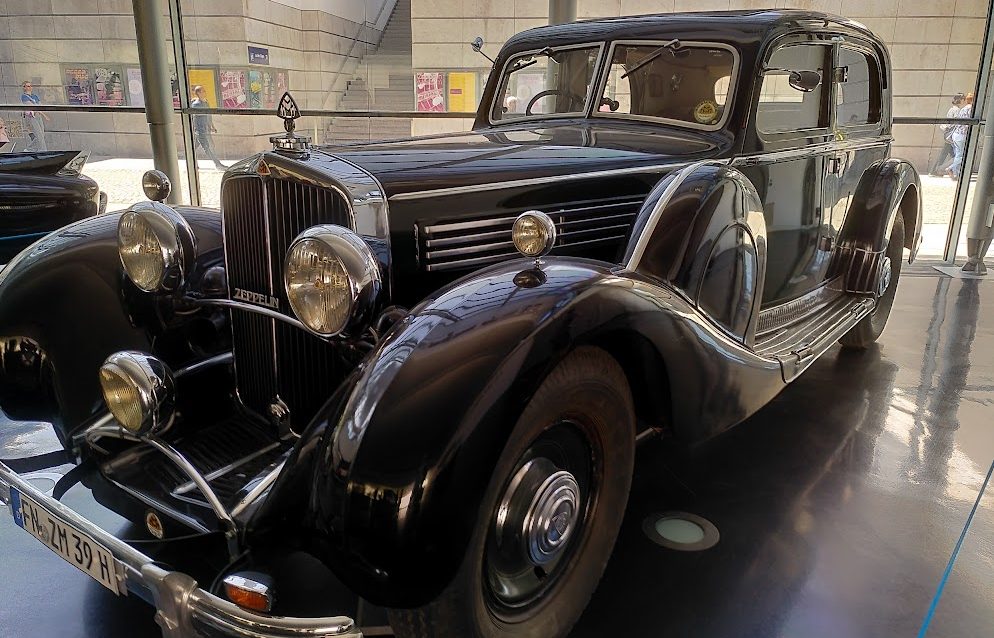
One of the things that a medieval citizen would surely remark would be the omnipresence of automobiles. How can a cart move by itself?
My explanation to our medieval visitor could run as follows. The steps are similar to how I would explain Generative AI to an interested layperson from 2025.
“How can cars move by themselves?”
Yes, cars move, but more importantly, they are steered by humans. There is a steering wheel, an accelerator pedal, turn signals, and more. They are designed so that the car behaves like the driver wants. There is also the bodywork that contains seats and storage place, and the wheels that you know from your medieval farm cart. It is just a cart without animals.
“How is it possible that AI seems to think?”
An AI chatbot interacts with humans. The chatbot has been designed and ‘trained’ to answer questions. To achieve this, clickworkers have endlessly indicated what is a good answer and what is not. They have put this into a website that you can use. Basically, it’s just a website with a smart computer behind it.
“But what makes it move?”
Cars can move by themselves because they have a motor. The motor runs on fuel: the fuel is converted into movement, and this movement is transferred to the wheels, so that the car goes forward. The fuel is burnt, and leaves the car as exhaust gases.
“But how can the chatbot give sensible answers?”
Chatbots can convert questions into answers because of the Transformer Model inside. It has been trained on a lot of text, and has thusly learned how language works. In fact, the Transfomer makes calculations with words. Specifically, it can add, subtract, multiply and divide (plus some other) the words in your question in a very long calculation with words. The most logical answer is then generated word by word and shown to you.
“But how does this motor work then?“
“How is fuel converted into movement?”
That’s what happened in the cylinders. You may have observed that dry matter sets fire and blows away the air with a lot of smoke. When you can have this fire in a small contained space, it can push away a piston. That movement can be converted into a turning movement which makes the wheels rotate.
“But how does such a transformer work? How is it possible to do arithmetic with words?”
The ability of such a transformer to make calculations with words is one of the most amazing principles of modern-day AI. The key for this to happen is the ‘word embeddings’ concept. A word embedding is basically to make a kind of statistical description of a word, based on the words that are usually found nearby. Some words rarely occur together, others more ofthen. The word “king” will be used rather with “palace” than with “chainsaw”.
On word can be represented with a long list of numbers: how often do you find “palace” nearby in the same sentence, how often do you see “chainsaw”, how often do you see “Windsor”. With some clever mathematical tricks you do not need to find a number for every word in the dictionary, but it can still be a list of tens of thousands of numbers for a single word like “king”.
Now the amazing part: it appears that this list of numbers, called embeddings, represent some kind of meaning. This enables you to make a calculation like “king” minus “man” plus “woman” yields “queen”. Or “Paris” minus “France” plus “Netherlands” is “Amsterdam”. This even works for more abstract concepts. You can add “the style of Shakespeare” to the user manual of a chain saw so you can read it like a sonnet. (Here, I go deeper into this.)
“So this car can get you anywhere?”
So you can drive a car. But they are only useful when you have roads to drive on. Plus you need places to get fuel. And there have to be traffic signs.
So transformers can calculate words. However, they are only useful when you have used really large amounts of textual data to create the embeddings: the training of the model. That’s why it’s called a Large Language Model. You need the internet to download all that data, and lots of computers and lots of electrical energy to do this. (More about that in another blog.)
“All these cars, doesn’t it get messy, then?”
The traffic signs bit was not apparent from the beginning. It became clear that when everybody started to use cars, accidents will happen. Therefore laws were made to define minimum requirements for cars: safety measures (like airbags and crumple zones) but also requirements for noise and exhaust. There are traffic rules, obviously. Plus: you need a driver’s licence to drive a car. Cars are nice and useful, but we don’t want to pay with that with noise, air pollution and traffic casualties.
That’s all very interesting and potentially useful, but there is a “but”. When you can use AI that is based upon those Large Language Models for almost everything that involves texts, there can be hazards. Therefore the AI Act was created: just like cars need to fulfill requirements, AI products have to comply as well. Existing rights need to be respecting, like intellectual property rights. Misuse needs to be prevented. There is even an analogy with the driver’s license: the AI Act requires that companies which let their employees use AI, have to provide them with a basic level of ‘AI literacy’. AI is nice and useful, but we don’t want to pay with copyright infringements, fake news and misuse by criminals. (In this blog, I compare the AI Act to Food safety laws.)
The analogy between cars and AI can be brought further. As practical as cars may be, you don’t use a car to walk your dog. There are many different types of cars: vans, buses, sports cars, etcetera. They all have motors, but you use them for many different things. The same holds for AI – more about that later.
 AI gedachten | thoughts
Plaats een reactie